

By Khoi Nguyen, P.E., GC. Professional Engineer, plan checker, licensed General Contractor.
A homeowner asks what the kitchen remodel runs. You text a number. Six weeks later she's holding that PDF, pointing at the total, asking why the invoice came in $9,000 higher.
What you called that document decides who wins that conversation. Quote, estimate, and bid carry three different legal weights, and on any given Tuesday all three words get used for the same PDF. Here's what each one binds you to.
Quote vs estimate: the short answer
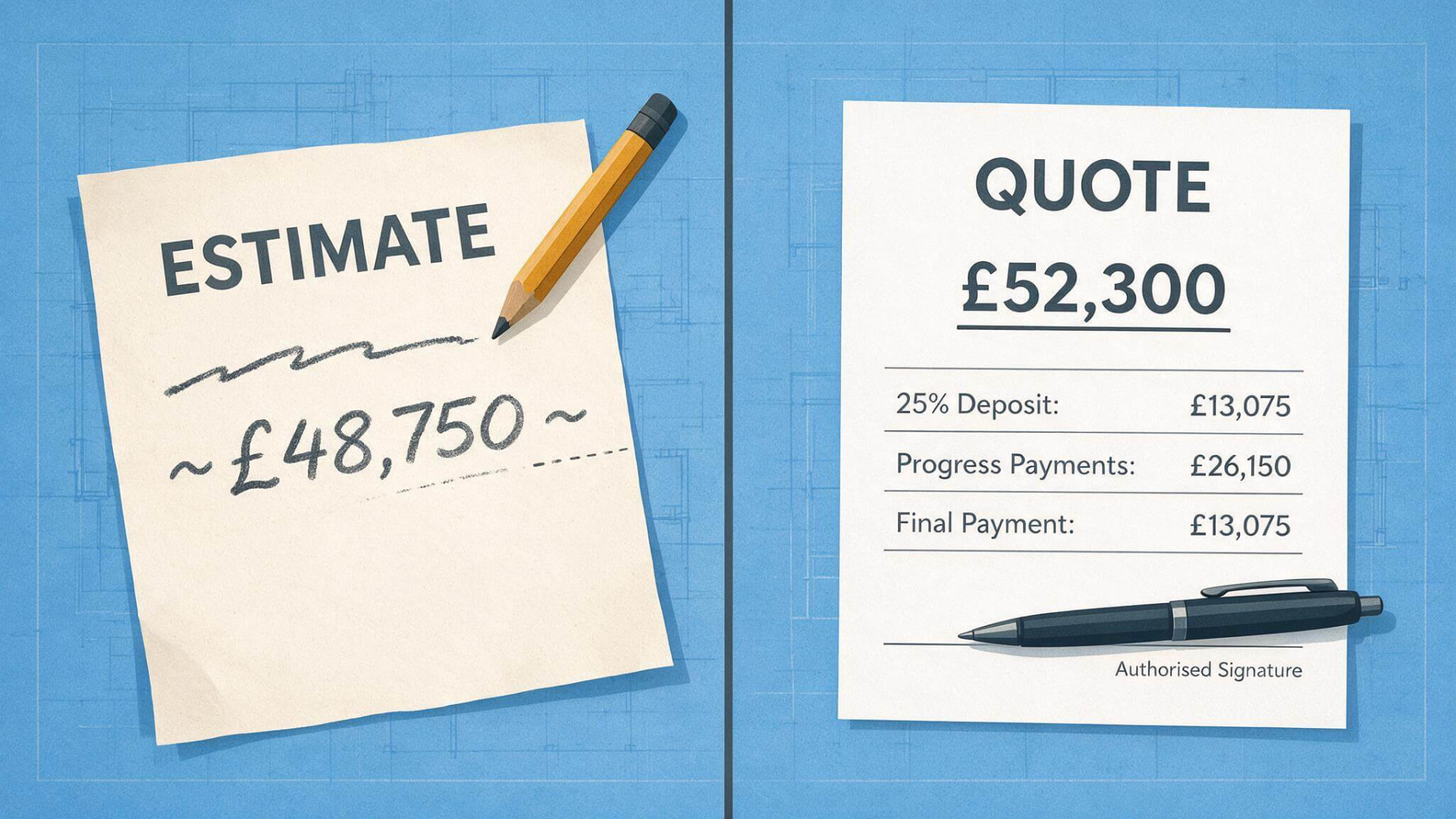
An estimate is your projected cost, and it isn't binding. A quote is a fixed price for a defined scope that becomes a contract the moment the client accepts it. A bid is a priced offer submitted into someone else's competition, and it's usually irrevocable for a stated window after opening.
| Estimate | Quote | Bid | |
|---|---|---|---|
| What it is | Projected cost range | Fixed price offer | Competitive priced offer |
| Binding? | No | Yes, once accepted | Yes, and often irrevocable 30 to 90 days |
| Who asks | Client, early | Client, ready to sign | Owner or GC, through an ITB or RFP |
| What backs it | Unit costs, partial drawings | Measured takeoff, sub quotes, supplier pricing | Full plan set, addenda, sub bids, bonds |
| Expires | No formal expiry | Stated date, commonly 30 days | Bid validity period in the front-end docs |
| Fails when | Client reads it as a price | Scope isn't nailed down | A sub pulls his number after you submitted |
Read that middle row twice. It's the only row that has ever cost anybody money.
What a construction estimate actually is
Your estimate is a cost figure. It is not a price, and it was never meant to leave your office in the form you built it.
AACE International sorts building construction estimates into five classes by how complete the design is. A Class 5 estimate sits on 0 to 2 percent design definition. Class 3, where most bid-tender work lives, needs 10 to 40 percent, and Class 1 needs 65 to 100.
The accuracy ranges track that maturity. AACE puts a building-construction Class 5 somewhere between minus 30 and plus 50 percent at the wide end.
So a 2,400 square foot addition you priced at $186,000 off a schematic set can land at $240,000 once the structural sheets show a moment frame and a deepened footing. That isn't you being sloppy. That's a Class 4 number behaving exactly like a Class 4 number.
Put the range on the page. If you send one figure off an incomplete set, the client remembers the figure and forgets the word "estimate" was ever on it.
What a quote is, and when it stops being optional
A quote is where you stop projecting and start committing. Fixed price, defined scope, stated expiry.
In California, any home improvement job over $500 in combined labor and materials has to run under a written contract under Business and Professions Code 7159. A one-page estimate with a total on it does not meet that bar.
CSLB also caps your down payment at $1,000 or 10 percent of the contract price, whichever is smaller. And because 7159 requires a total price and a payment schedule in dollars at signing, straight time-and-materials and cost-plus agreements don't clear the requirement for home improvement work.
Here's the part that catches people. Courts read the document, not the header.
Put a fixed total, a signature line, and a payment schedule on a page that says "Estimate" across the top and you've written a quote. The label buys you nothing. What buys you something is a scope section tight enough that both of you know what's excluded.
What a bid is, and why it's the one that bites
A bid is a quote you submit into a competition you don't control, usually against a deadline someone else set.
Go back to Drennan v. Star Paving, decided by the California Supreme Court in 1958.
A paving sub phoned in $7,131.60 on bid day. The GC carried that number into his prime bid, won the job, and the sub tried to walk over a mistake.
The court wouldn't let him. Reasonable reliance made the bid irrevocable, and the GC collected $3,817, the gap between the phoned-in number and what the work actually cost to buy.
That case is why your sub's number is a bid and not a quote. Once you carry it into your own submission, he's stuck with it, and so are you.
Public work formalizes the same idea. Georgia's public works code requires a bid bond of at least 5 percent on jobs over $100,000 and blocks withdrawal of a sealed bid for 60 days after opening. Federal work sets the bid guarantee higher, at 20 percent of the bid price with a $3 million ceiling, under FAR Part 28.
Sixty days is a long time to hold a lumber number.
Estimate vs bid: the distinction almost nobody draws
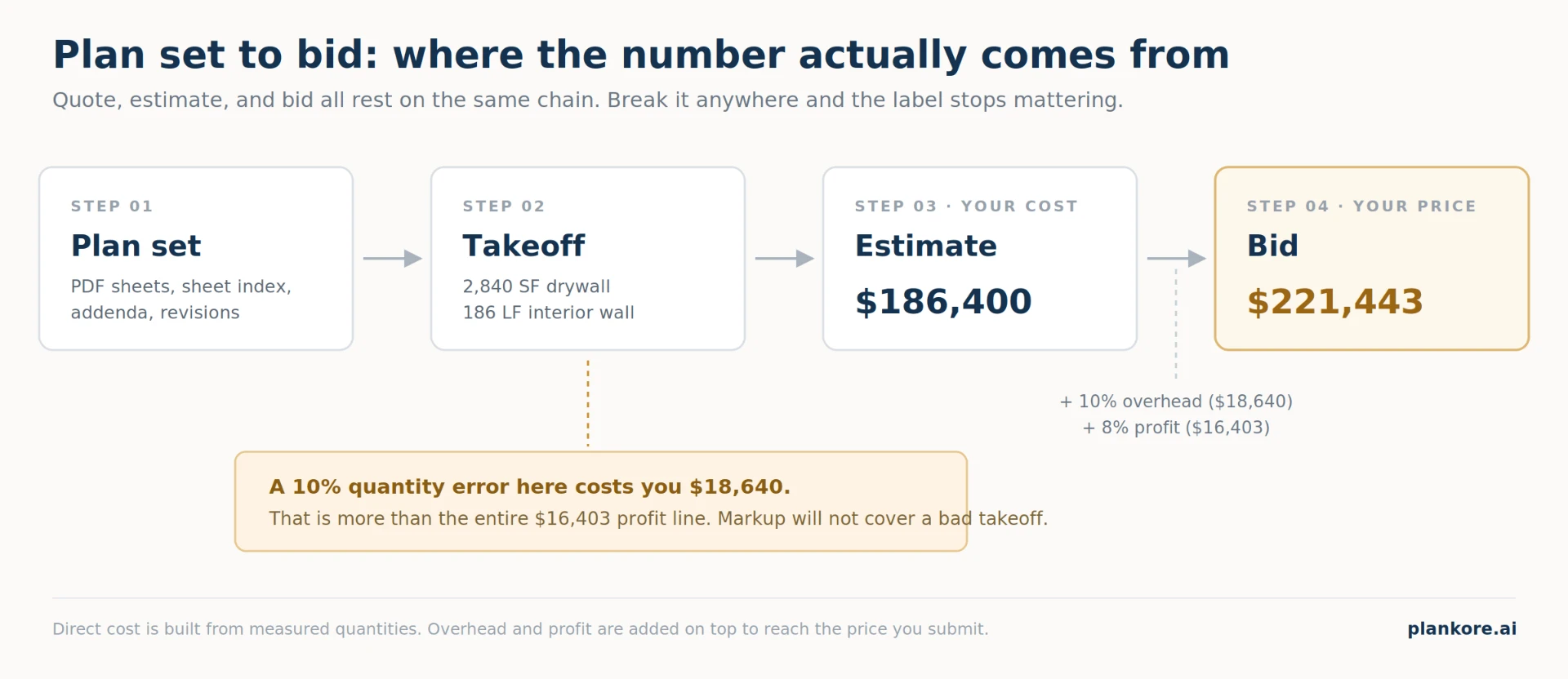
Your estimate is your cost. Your bid is your price. They are two documents and they should never walk out the door together.
| Line | Amount |
|---|---|
| Direct cost from takeoff | $186,400 |
| Overhead at 10% | $18,640 |
| Subtotal | $205,040 |
| Profit at 8% | $16,403 |
| Bid price | $221,443 |
The $186,400 is the estimate. The $221,443 is the bid. Email the wrong one and you've handed a client your cost structure and your margin in the same attachment.
Now run a takeoff error through it. If your framing and drywall quantities come in 10 percent light, that's $18,640 of direct cost you never priced, which is more than the entire profit line.
Your markup didn't save you there. Your takeoff either caught it or it didn't.
Three ways this paperwork fails on real jobs
No expiration on the quote. You priced dimensional lumber in March and the client signs in July. Thirty days in writing, then requote, and it costs you one sentence to add.
Scope written by trade instead of by quantity. "Drywall: install per plan" is not a scope. "2,840 square feet of 5/8 type X, level 4 finish, walls and ceilings, garage excluded" is a scope, and it's the difference between a change order and an argument.
Allowances covering for a takeoff you never did. A $6,000 tile allowance on a bathroom you haven't measured isn't a number, it's a placeholder wearing a number's clothes. The client will treat it as a price anyway.
All three are the same failure underneath. The document made a commitment the takeoff behind it couldn't support.
Where the number came from matters more than what you call it
Every one of these documents is the same chain: quantities, then cost, then price. Takeoff feeds the estimate, the estimate feeds the bid or the quote.
Break the chain anywhere and the label stops mattering. You can write "estimate" on a page all day. If the client disputes the invoice and you can't show which sheet the 2,840 square feet came from, you're negotiating from memory.
That traceability is the whole reason we built Plankore the way we did. Every quantity carries the source sheet, the formula, and the assumption behind it, so when someone questions a line you open the plan instead of your notes.
Free Forever is free, no credit card, and covers area, linear, and count takeoff plus an Excel-style estimating grid with cost, waste, and markup. Export in your own bid format when you're ready to send. It runs in the browser on Mac, Windows, or a Chromebook, which matters because most of the established desktop tools are Windows only.
If plan volume is the bottleneck rather than the math, Plankore Pro adds AI wall, area, window, and door detection. It's in beta, it drafts the first pass, and you still verify every number before it reaches a bid. See the full pricing breakdown or start with the free takeoff tools.
So which one do you send
Send an estimate when the drawings aren't done, say so in writing, and give a range instead of a single figure. Send a quote when you've measured the work and you'll hold that number for 30 days. Send a bid when someone else set the rules and the clock.
The document you send is a promise about how sure you are. Make sure the takeoff behind it earns that promise. Start free and price your next job off measured quantities instead of a feeling.
Price your next job off measured quantities
Plankore Free Forever. No credit card required.
Start freeFrequently asked questions
A quote is legally binding once the client accepts it, because it states a fixed price for a defined scope. An estimate is a projection and generally isn't binding. Courts look at the content of the document rather than its title, so a fixed total with a signature line reads as a quote either way.