
What free takeoff software actually means
Free takeoff software lets you measure quantities off a plan set without paying for a license. Most tools using the word "free" mean a 14 day trial, a demo, or a viewer that measures but won't price anything. A genuinely free plan has no expiry date and no card on file.
The difference matters on bid day.
Here's the test worth applying. Can you sign up tonight, measure a real sheet, and get the numbers out into your own spreadsheet without talking to anyone?
If any part of that needs a sales call, it isn't free. It's a lead form.
The catch in every free takeoff tool
Every free option in this category has a limit somewhere. The vendors just put it in different places, and they rarely put it on the pricing page.
| Tool | Free plan? | What you actually get | Where it stops |
|---|---|---|---|
| Plankore Free Forever | Yes | Area, linear, and count takeoff, estimating grid, Excel export | 3 projects per month, 3 editors |
| Bluebeam Revu | No | Trial only | Dynamic Fill sits on the $440 Complete tier |
| PlanSwift | No | Form, then a sales rep calls you | Annual license, Windows only |
| On-Screen Takeoff | No | One page web preview of Takeoff Boost | No pricing published anywhere |
| Togal.ai | No | Demo booking form | Every button on the site goes to the same form |
| Square Takeoff | No | 14 day trial behind a 9 field form | Trial expires, no free tier underneath |
Access models confirmed from vendor pages, August 2026. Prices move, so check before you buy.
The pattern is worth naming. Four of these tools sell an annual license, so a free plan would eat their own revenue. They can't ship one.
That's not a criticism, it's just the math of their business model, and it's why "free" in this category usually means "free until we call you."
Free trial and free plan are not the same thing
A trial is a countdown. A free plan is a floor.
This sounds obvious until you're 11 days into a 14 day trial with a bid due Thursday and a half finished takeoff sitting in a tool you're about to lose access to. That's the moment people find out which one they signed up for.
The second thing to check is what happens to your work when the free window closes. If your quantities live inside the tool and there's no export, you're not testing software, you're building a hostage. Excel export is the only thing that makes a free plan safe to actually rely on.
Looking for a free version of On-Screen Takeoff or PlanSwift?
There isn't one, and it's worth saying plainly rather than sending you around in circles.
On-Screen Takeoff is a ConstructConnect product and doesn't publish pricing at all. What it offers is a single page web preview of Takeoff Boost, its AI feature. You upload one sheet, you see a result, and then you book a demo.
PlanSwift is the same company, running the same AI engine. Its trial is a form that triggers a call from a sales specialist who emails you a license key.
Both are Windows desktop software. If your shop runs Macs, that decision is already made for you before anyone quotes a price.
What you get with Free Forever
Free Forever costs $0 with no credit card and no trial countdown. The limit is 3 projects and plan uploads per month, stated up front rather than buried.
For comparison, the cheapest paid seat in this table is Bluebeam Basics at $260 per year, and that tier doesn't include Dynamic Fill.
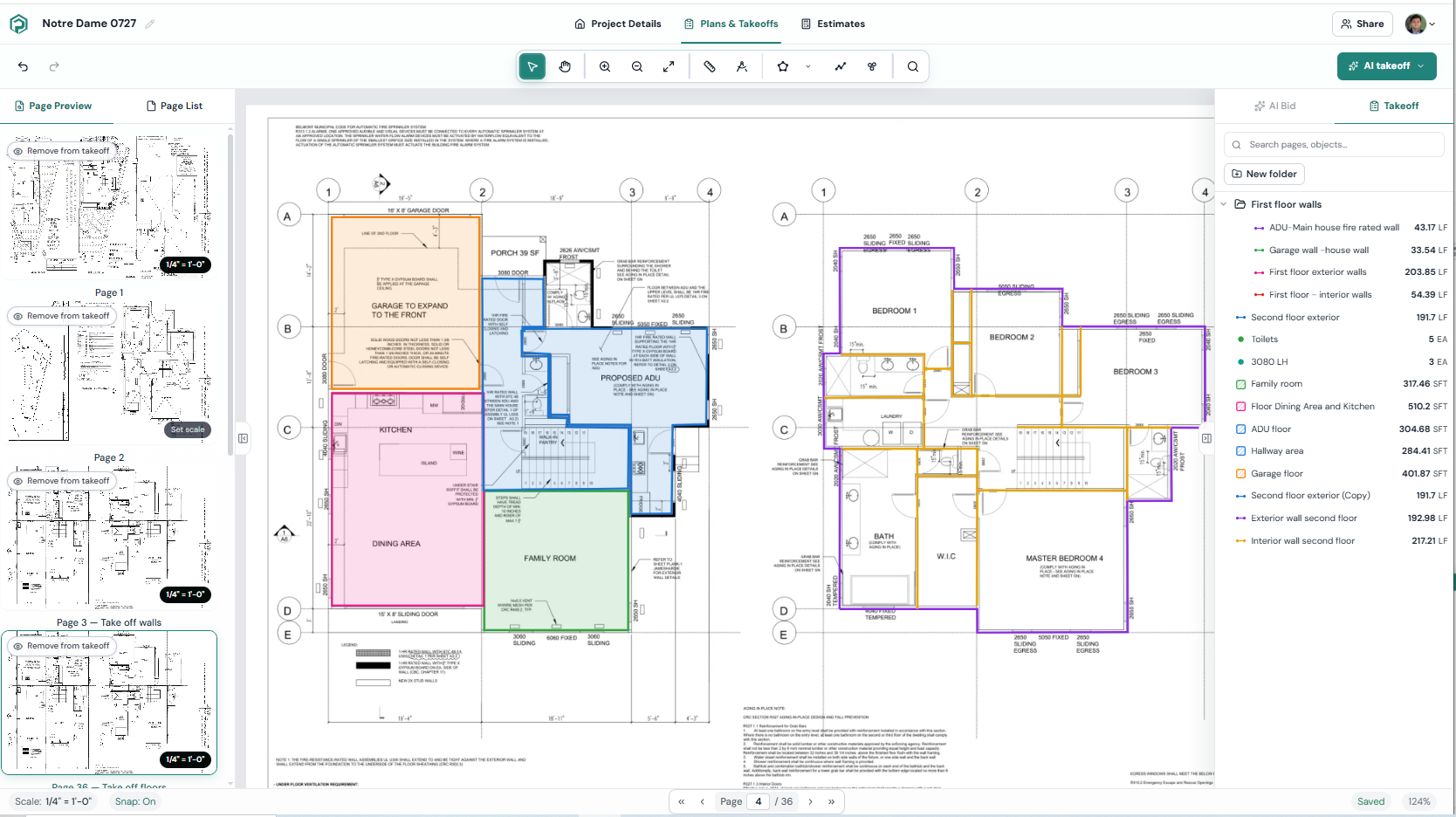
Inside that, you get area, linear, and count takeoff on any sheet, commercial or residential. You get an estimating grid with cost, waste, and markup, so the quantities turn into a priced job instead of a list of numbers. And you get Excel export in your own bid format, at any time, so nothing you build is locked in.
It runs in a browser on Mac, Windows, or Chromebook. Nothing to install, which matters more than it sounds when the tool you're trying out needs IT to approve a desktop install first.
Three editors and unlimited viewers are included, so a partner or a PM can look at the same takeoff without buying a seat.
When free takeoff software isn't enough
Free works until throughput becomes the problem.
If you're bidding 20 jobs a month, a 3 project cap is a trial with extra steps, and you should say so to any vendor including us. The honest read: Free Forever fits an owner-operator doing takeoffs after hours, or anyone testing whether digital takeoff beats the highlighter before committing budget.
The other ceiling is manual measurement. Free Forever measures what you tell it to measure.
If you want AI to run the first pass on a 40 sheet set, that's Plankore Pro, a paid tier in beta at early access pricing. AI speeds up the first pass, you still check the numbers. Full tier breakdown is on the pricing page.
Frequently asked questions
Is there any genuinely free construction takeoff software?
Yes, though the field is small. Plankore's Free Forever plan needs no credit card and has no expiry, capped at 3 projects per month, and includes estimating and Excel export. Most tools advertising "free takeoff software" are running a 14 day trial or a demo booking form, not a free plan.
Can I do a takeoff for free without downloading anything?
Yes. Browser based takeoff tools run on Mac, Windows, and Chromebook with nothing to install. This is the main practical gap between newer cloud tools and the established desktop products like PlanSwift and On-Screen Takeoff, which are Windows only and need a local install.
What's the difference between a free takeoff tool and a free trial?
A free trial expires on a fixed date, usually 14 days, and normally needs a credit card or a sales form to start. A free plan has no end date. The question that separates them: what happens to your quantities when the window closes, and can you export them first?
Does free takeoff software include estimating?
Usually not. Most free or low cost takeoff tools measure quantities and stop there, leaving you to build the estimate in a spreadsheet. Free Forever includes an estimating grid with cost, waste, and markup, plus Excel export, so the measurement and the price live in the same place.
Is free takeoff software accurate enough for real bids?
Accuracy depends on scale calibration, not price. Set your scale off a known dimension rather than trusting the title block, because reissued and reprinted sets drift. Any tool that shows you the source sheet and the formula behind a quantity lets you check the math yourself, which is what actually protects a bid.