

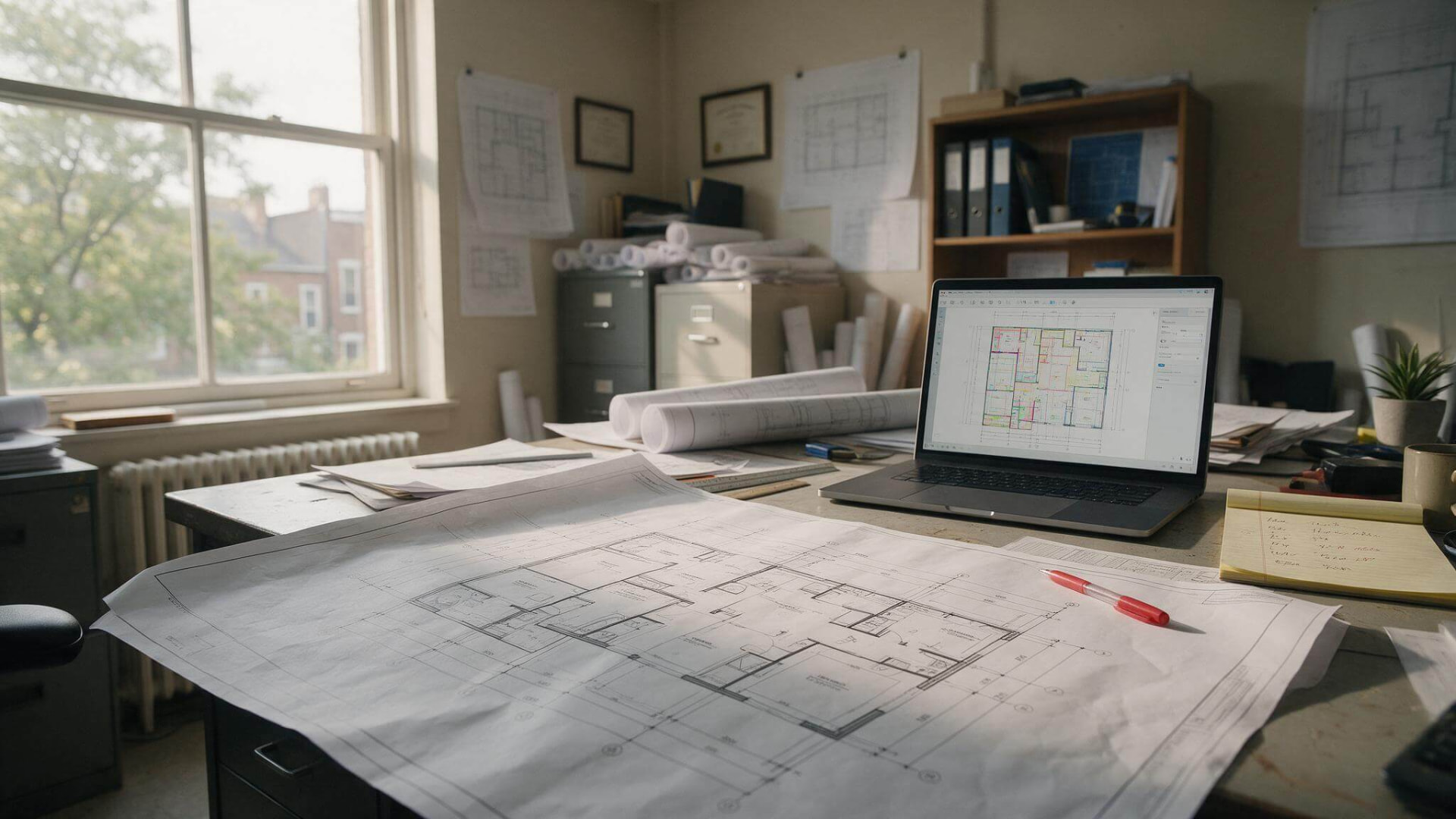
Most job descriptions for this role say the estimator "calculates project costs." That sentence covers about a third of the work and none of the hard part. The hard part is deciding what the drawings don't say, whose sub bid is missing a scope, and how much risk to price before a competitor prices less. Here's the job as it actually runs, hour by hour, with pay data from 2026 and an honest read on what AI has changed.
What does a construction estimator do?
A construction estimator prices a project before it gets built. They read the plan set and specs, measure quantities off the drawings, price labor, material, and equipment, collect and compare subcontractor bids, add markup and contingency, and assemble the number the company submits on bid day. They work in preconstruction, and their output is a commitment the company has to live with.
That last part is what separates the role from accounting. An accountant reports what a job cost. An estimator promises what it'll cost, in writing, months before anyone pours footings.
Get it wrong by 4% on a $1.9M job and you've given away $76,000 of margin. Nobody finds out until the job is halfway framed.
What a construction estimator does on a single bid
Here's where the hours go. This is a 68 sheet package for a ground-up light commercial building, roughly $1.9M, bid over 9 working days by one estimator.
| Task | Hours | Where it goes sideways |
|---|---|---|
| Read the set and specs, build a sheet index | 3 | Detail sheets contradict the plan sheets |
| Site visit and existing conditions | 4 | Access, staging, and dirt nobody drew |
| Quantity takeoff | 11 | Scale drift on scanned sheets |
| Pricing: unit costs, waste factor, labor rates | 5 | Cost database is 14 months stale |
| Chasing and leveling subcontractor bids | 6 | Two subs quoting two different scopes |
| RFIs and addenda rework | 3 | Addendum 3 lands Friday at 4pm |
| Markup, contingency, final review | 2 | Nobody wants to own the number |
| Proposal assembly and upload | 2 | Portal rejects the file at 1:52pm |
Thirty-six hours. Look at the split: the quantity takeoff is 11 of them, under a third. The other 25 hours are judgment, phone calls, and rework.
That ratio is the most misunderstood thing about this job. People outside it assume estimators spend the week measuring. Estimators spend the week deciding.
Takeoff, estimate, bid: the distinction estimators draw and outsiders skip
These three words get used interchangeably in job postings, and they're three different deliverables produced at three different points.
| Term | What it is | Who sees it |
|---|---|---|
| Takeoff | Measured quantities pulled off the drawings: 1,840 linear feet of 2x6 wall, 312 sheets of 5/8 drywall, 47 doors | Internal only |
| Estimate | Those quantities priced with unit costs, labor, waste, and equipment. An internal cost picture | Internal, sometimes the owner |
| Bid | The estimate plus markup, contingency, exclusions, and terms, submitted as a binding offer | The owner or GC |
An estimate is a working number you can still change. A bid is a promise with your company's name on it. We wrote a separate piece on quote versus estimate if you want that line drawn properly.
The mistake I saw constantly on plan check was contractors treating a takeoff as an estimate. Counting 47 doors isn't the same as pricing 47 doors.
Twelve are rated assemblies with closers and 3 are storefront. On that door schedule the spread between the cheapest unit and the priciest one runs 8 to 1.
What a construction estimator does that has nothing to do with math
The measuring is the part you can teach in a month. The rest takes years.
Bid leveling. Four drywall subs send four numbers. One excludes fire caulking, one carries level 5 finish where the spec says level 4, one assumes the GC provides the lift.
Leveling means putting all four on the same scope so the numbers can be compared. It's where most of the money hides.
Scope gap hunting. Every plan set has work that falls between two trades. Nobody bids the blocking behind the grab bars.
Nobody bids the roof curbs either, because mechanical assumed the roofer had them and the roofer assumed mechanical did. Those gaps become change orders, or they come out of your margin.
Go or no-go. A good estimator kills bids. If the schedule is impossible, the retainage terms are ugly, or 3 of your competitors are hungrier than you this quarter, the right answer is to not spend 36 hours.
Chief estimators say no more often than they say yes.
Feeding the cost database. After a job closes out, somebody has to compare the estimate against the actual. Shops that skip this bid the next job on 3 year old numbers and wonder why they keep winning work they lose money on.
Relationship maintenance. The sub who sends his number at 3:40pm on a 2pm bid day isn't a scheduling problem. He's a relationship problem, and you fix that in the 11 months between bids.
What does a construction estimator make?
The U.S. Bureau of Labor Statistics puts the median annual wage for cost estimators at $78,740 as of May 2025. That figure covers all cost estimators, not just construction, and construction roles carrying real bid risk price above it.
Here's what shows up in 2026 construction job postings by level.
| Level | Typical range | What they own |
|---|---|---|
| Junior estimator, 0 to 3 years | $62,000 to $88,000 | Takeoffs, quantity checks, bid packages |
| Estimator, 4 to 8 years | $88,000 to $125,000 | Full estimates, sub leveling, owner meetings |
| Senior or chief estimator, 9+ years | $125,000 to $180,000 | Final number, go or no-go calls, the cost database |
| Preconstruction manager | $140,000 to $190,000 | A team of estimators, client-facing precon |
Two things move pay faster than years of service. Sector is one: data centers, life sciences, and heavy civil pay well above general commercial.
Sign-off authority is the other. The moment you're the person who owns the final number, compensation jumps, because the company is paying somebody to carry that risk.
Read the BLS outlook honestly. Employment of cost estimators is projected to decline 3 percent from 2025 to 2035, and BLS still projects about 17,600 openings a year, almost all from retirements and people leaving the field. Fewer seats, and most of the current ones turning over.
How do you become a construction estimator?
There's no license. That surprises people who assume this works like a P.E. or a GC license, where a state board gates entry.
Anybody can call themselves an estimator tomorrow.
Two common paths in. The first is a construction management, civil engineering, or building science degree straight into a junior estimator seat at $62,000 to $88,000.
The second is the field: a carpenter or foreman with 10 years of production knowledge who moves into the office. That's the path that produces the best estimators I've worked with, because they already know how much 2x6 wall a 3 man crew frames in a day.
Certifications carry weight, but they follow experience instead of replacing it. The Certified Professional Estimator from the American Society of Professional Estimators asks for 5 years of on-the-job estimating experience before you can start the program, plus a written exam and renewal every 3 years. AACE International runs the Certified Estimating Professional credential on a similar model.
Skip the certification until year 5. Before that, what moves your career is closing the loop on your own bids and seeing where you were wrong.
Is AI replacing the construction estimator?
No, and the 36 hour table above shows why. AI is fast at the 11 hours and useless at the other 25.
Detection models read walls, doors, windows, and areas off a plan sheet, and they set the scale. That compresses the measuring pass. What they don't do is call the mechanical sub about the roof curbs, decide whether 6% contingency covers a site with unknown soils, or catch that Addendum 3 moved a demising wall and quietly changed 4 sheets.
Here's the honest version, because this category is full of accuracy percentages no vendor has ever let anyone verify. AI drafts the first pass, then you check it against the sheet. Anyone selling hands-off automated bidding is selling something they can't back up.
The estimators getting squeezed are the ones whose whole value is measuring speed. The ones pricing risk and leveling scope are worth more, not less, because a smaller pool of them is covering more bids.
The tools a construction estimator actually uses
Excel is still the backbone in most shops, and it will be for a long time. Around it sits the measurement layer, and that's where the category has been stuck.
| Tool type | Common options | The catch |
|---|---|---|
| PDF measurement, desktop | PlanSwift, On-Screen Takeoff | Windows only, license tied to a machine |
| Markup and review | Bluebeam Revu | Built for markup, estimating is thin |
| Cloud takeoff and estimating | STACK, Plankore | Browser-based, works on Mac |
| AI detection | Togal.AI, Kreo, Plankore Pro | Beta-stage across the board, still needs review |
If your shop runs Macs, half of that first row is closed to you before you book a demo. Desktop takeoff software has been Windows-only for two decades. The workaround has been a virtual machine or a second laptop nobody wants to maintain.
That's the part we built around. Plankore Free Forever runs in a browser on Mac, Windows, or a Chromebook, handles area, linear, and count takeoff, and exports to Excel in your own bid format.
It's free with no credit card and no sales call, which puts it in a different bracket from a $1,749 a year desktop seat or a $2,999 a year cloud seat. Plankore Pro adds AI wall, area, window, and door detection. See current pricing.
We build it this way for traceability. Every quantity shows the sheet it came from and the math behind it, so your review pass is a check instead of a leap of faith.
The part of a construction estimator job nobody automates
If you're weighing this career, take the seat. BLS projects 17,600 openings a year, pay tracks to how much risk you're trusted to carry, and the other 25 hours of judgment have no replacement in sight.
If you're a contractor doing your own estimating after dinner, the question is narrower. You're spending 11 hours of every 36 measuring, and that's the part software handles now.
Start with free takeoff software, or read our walkthrough on how to bid construction jobs first.
Frequently asked questions
An estimator prices the whole project for a contractor, including labor, equipment, markup, and risk. A quantity surveyor, a role common in the UK, Australia, and Canada, measures quantities and manages cost and contracts through construction instead, and in the U.S. market the estimator absorbs most of that scope.
Start free, no credit card
Plankore Free Forever covers area, linear, and count takeoff with Excel export.
Start free